14 Must-See Paintings at the National Gallery in London
Text & photography by Anna Kmiecik, private tour guide in London. Polish version of this guide is also available.
The National Gallery in London is home to over 2,300 paintings.
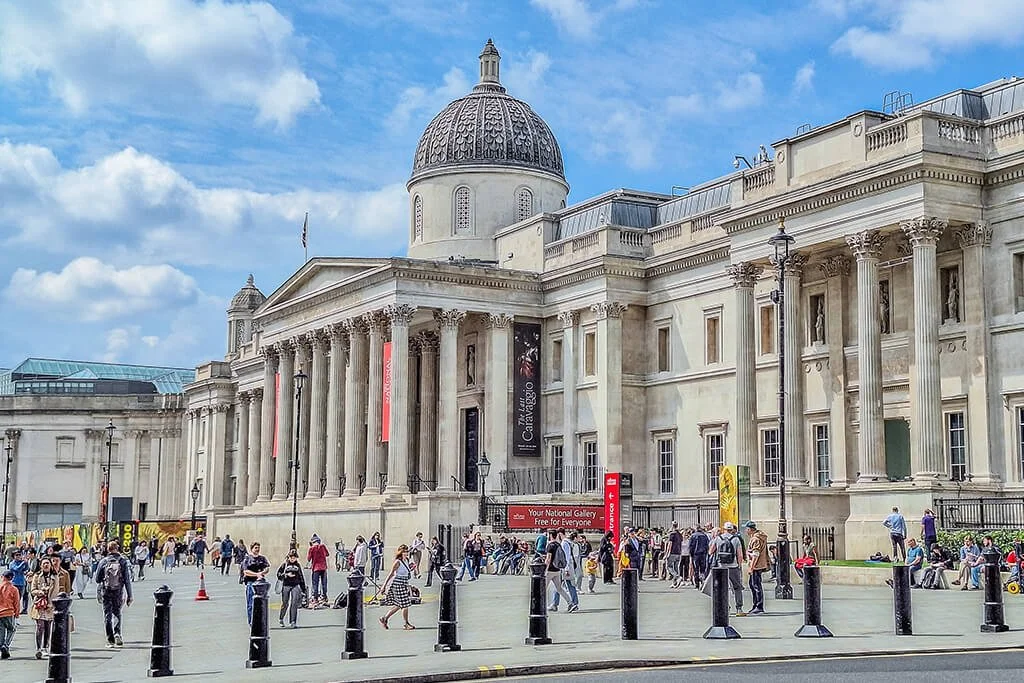
Its collection includes pieces authored by most famous names in an art world from the 13th to the 20th century.
Being centrally located and accessible to everyone free of charge (operating on a donation basis), it is the ultimate destination for art lovers visiting London.
To book a free ticket click here!
Below, you will find a list of 14 must-see paintings in the National Gallery that you shouldn’t miss during your visit.
How much time do you need to visit the National Gallery?
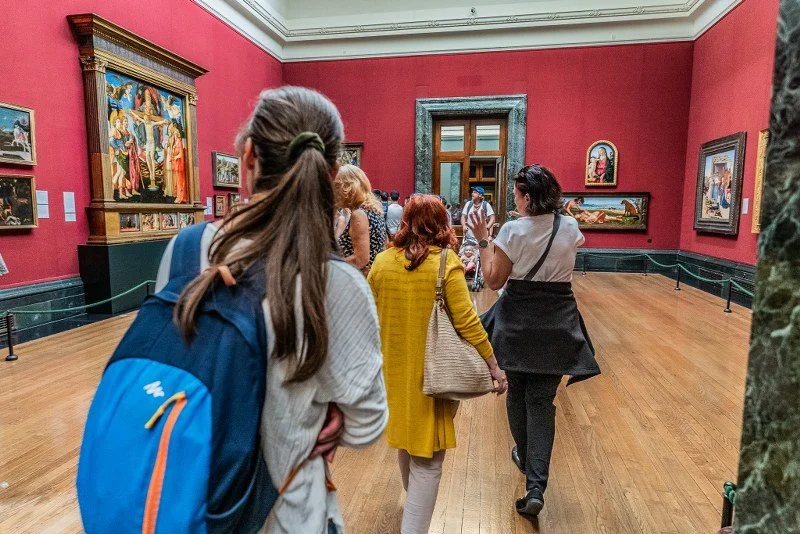
The amount of time needed to visit the National Gallery can vary depending on your interests. For a first visit, I recommend dedicating 1-2h.
Visiting London, Oxford or Cambridge?
See my free self-guided walks — used over 1 million times by people from around the world.
Must-See Paintings at the National Gallery
Clicking on the title of each painting below will allow you to view it in greater detail on the National Gallery website.
1. Sunflowers, Vincent van Gogh (1888, room 43)
One of the most famous paintings by one of history’s most influential artists, Vincent van Gogh.
The Dutch painter had a tragic personal story, dying by suicide at the age of 37 and not witnessing the success of his creations.
Despite struggling throughout his short life with mental illness and poverty, he produced over 2,100 artworks, some of which are displayed in the National Gallery.
Without a doubt, his Sunflowers is the most visited painting at the Gallery.
2. The Burlington House Cartoon, Leonardo da Vinci (c. 1499-1500, room 51a)
The Burlington House Cartoon is over 500 years old and remains the only surviving large-scale drawing by the Italian genius Leonardo da Vinci.
The drawing was probably a preparation for a now-lost or never-executed painting.
It was also used as a source for paintings by others.
The Burlington House Cartoon depicts the Virgin Mary, her mother Saint Anne, the Christ Child, and the young John the Baptist, and it is one of the greatest treasures in the National Gallery collection.
3. Virgin of the Rocks (c. 1491–1508, room 51)
In Room 51, you can also find a painting most likely designed by Leonardo and probably executed by his assistants.
This painting depicts the Virgin Mary and child Jesus with the infant John the Baptist and an angel, set in a rocky landscape, hence the name of the painting.
The Louvre has an earlier version of the Virgin of the Rocks painted by the artist himself in its collection.
4. Unfinished paintings by Michelangelo, (c. 1500-01, room 2 & 51)
In the National Gallery collection, you can also find two unfinished paintings by the Italian Renaissance genius Michelangelo.
One is The Entombment, depicting the burial of Jesus.
In 51, The Manchester Madonna, showing the Virgin Mary, the Christ Child, St. John the Baptist, and angels.
5. The Arnolfini Portrait, Jan van Eyck (1434, room 52)
A 600-year-old painting depicts a wealthy couple, believed to be Giovanni di Nicolao di Arnolfini and his wife, standing in a lavishly decorated room, with a convex mirror reflecting the Flemish artist Jan van Eyck himself.
6. The Thames below Westminster, Claude Monet (1871, room 41)
The National Gallery in London has a notable collection of paintings by Claude Monet, the French painter and founder of Impressionism, who visited London multiple times throughout his life.
Apart from his famous water lilies-themed paintings (room 46), you can also see some of his works featuring London, such as The Thames below Westminster.
7. Paintings by Canaletto
Room No. 33 of the National Gallery serves as a home for various pieces by the Italian painter Canaletto.
Between 1749 and 1755, he spent some time in England producing various views of London (famously depicting Westminster Abbey, Westminster Bridge, and Greenwich), but the gallery’s space is dominated by his paintings of his home city of Venice.
8. Samson and Delilah, Peter Paul Rubens (c. 1609–1610, room 18)
If you are an admirer of Peter Paul Rubens’ art, you will be spoiled for choice, as the National Gallery is home to a significant number of pieces by this famous Flemish painter.
9. The Ambassadors, Hans Holbein the Younger (1533, room 4)
Almost 500 years old, this wonderfully complex painting depicts a double portrait by one of the greatest portraitists of the 16th century, the German-Swiss painter Hans Holbein the Younger.
The painting includes an anamorphic skull that can only be properly viewed from a specific angle, adding a strange and intriguing element to the work.
10. Fruit Dish, Bottle and Violin, Pablo Picasso (1914, room 45)
In Room 43 of the National Gallery, you can find pieces by the co-founder of Cubism and arguably the most famous artist of the 20th century, the Spanish painter Pablo Picasso.
He was exceptionally prolific throughout the course of his long life and lived to see his fame and gain significant fortune due to his creations.
Picasso left behind almost 2,000 paintings, over 1,000 sculptures, countless drawings, and prints.
11. The Gallery’s oldest painting ( c. 1263–64, room 65)
The altarpiece by Italian painter Margaritone d’Arezzo is the oldest piece in the National Gallery and is 750 years old.
The painting depicts Madonna and Child, with eight smaller scenes from the lives of saints on the sides.
The artist was one of the first Italian artists to sign his works, including this one.
12. The Gallery’s first stolen painting (featured also in the first James Bond movie!)
In Room 38, you can see Francisco de Goya’s Portrait of the Duke of Wellington (c. 1812-14).
This painting of an important national hero went missing from the National Gallery exactly 50 years after the famous theft of the Mona Lisa from the Louvre – both paintings were stolen on August 21st.
Leonardo da Vinci’s Mona Lisa was stolen in 1911, and The Portrait of the Duke of Wellington in 1961.
Despite the suggestion in the first James Bond movie (screened in 1962) that the painting was in the possession of the villain Dr. No…
… it was later discovered (in 1965!) that it was actually stolen by a retired bus driver who was demanding free TV licences for pensioners in the UK! :)
Another fun fact!
The prop painting used in the movie, painted over one weekend by the movie production designer, also went missing after filming.
13. The Execution of Lady Jane Grey, Paul Delaroche (1833, room 38)
Lady Jane Grey was a 17-year-old queen executed on February 12, 1554, by the order of Queen Mary I at the Tower of London.
Seeing the painting portraying the moments preceding her death is a great introduction to the long and brutal history of executions in London.
If you enjoyed this painting, you might also like the final painting on this list…
14. Witches at Their Incantations, Salvator Rosa (c1646, room 32)
Painted by one of the most original Italian artists of the 17th century, who, among his various subjects, chose to depict scenes of witchcraft.
This painting is both captivating and unsettling.
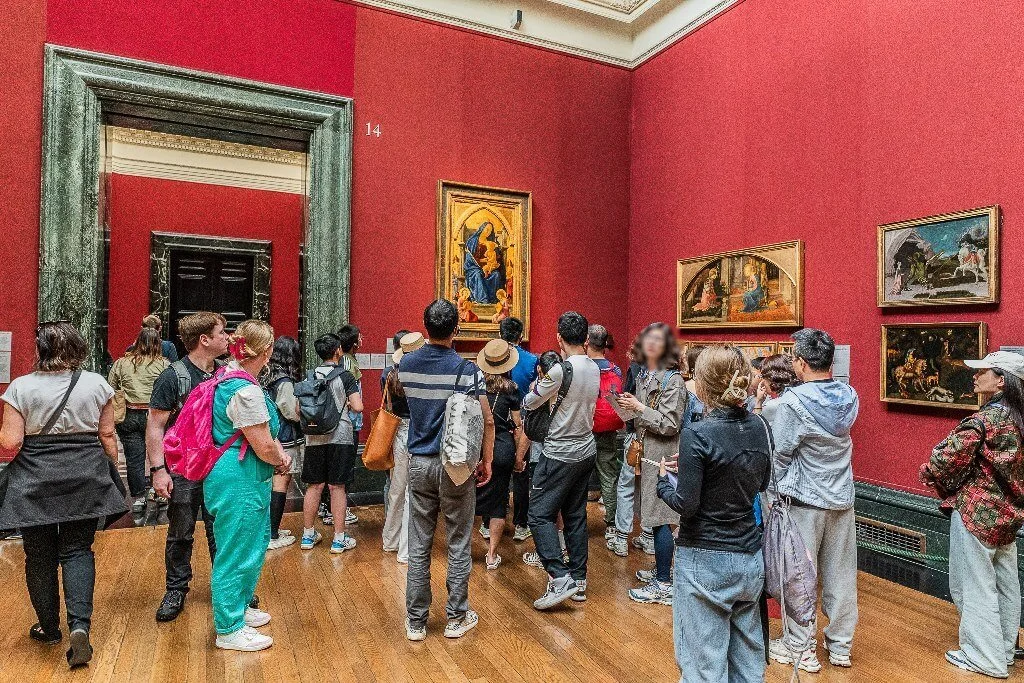
Obviously, the pieces described above are only a fraction of the collection at the National Gallery, but I hope I have managed to convince you that the Gallery is worth visiting!
Visiting London, Oxford or Cambridge?
See my free self-guided walks — used over 1 million times by people from around the world.

What & where to eat in London?
Discover 6 must-try British food experiences — from hidden gems to spots I personally take my tour guests to. Created by a London guide whose self-guided walks have been used over 1 million times worldwide. 👉 Get the insider guide here.